
E-Bike Legislation to Watch in 2026
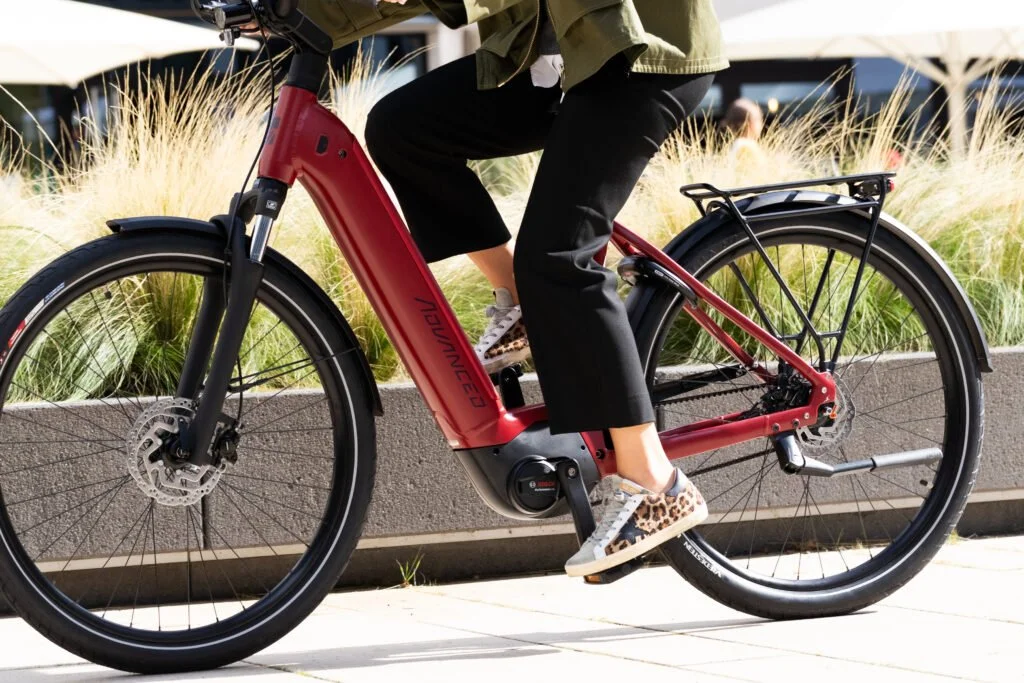
Photo credit: Farrally Atkinson
This post was updated April 24, 2026.
As e-bikes and e-devices surge in popularity and become more common on our streets, there is a need to provide proper education, infrastructure, and market regulation to prohibit the sales of e-motos (different than legal e-bikes!).
You can read our 2-part stance on e-bike policy here, which also recommends that e-bike policy come from the state level. No one wants laws to change when crossing city or county lines. Unfortunately, we’re seeing patchwork policies being proposed and applied from the school district to the county levels.
It’s important that state laws don’t prohibit or impede access and incentives to safe, legal e-bikes. Legal e-bikes, especially those that reduce the amount of car trips, will reduce traffic violence on our streets and improve safety for everyone.
Here are a few bills we’re supporting ✅, opposing ❌, and watching 👀:
✅ SB1167-Blakespear: Identifies consequences for selling illegal e-bikes
One of the more difficult aspects of regulating e-devices is that while many may look like an e-bike, they are not a legal e-bike.
The real issue is that some youth and adults are riding electric motorcycles or e-motos that look like e-bikes without proper licensing or education, and many parents and the general public are unaware of the difference. Lawmakers are also misidentifying the problem by regulating all e-devices and not distinguishing between illegal e-motos. We wouldn’t allow youth to drive an SUV without driver's education and licensing, and the same is true for motorcycles. At the same time, it’s clear that our youth want more mobility options—the freedom to get around, socialize, and have fun with friends.
SB1167-Blakespear, co-sponsored by our friends at Calbike, aims to better regulate powerful devices that may look like e-bikes, but are not. It does this many ways, including:
It would make it illegal to advertise, sell, or label something as an e-bike that is not legally so. (An e-bike must have fully operable pedals and an electric motor no more than 750 watts according to current vehicle code.)
Violations could be considered false advertising under the state Business and Professions Code, creating a new enforcement tool against sales of illegal e-bikes and deceptive marketing.
Sellers would need to disclose when something is not an e-bike and failing to do so would be a misleading statement under state false advertising law.
❌ AB1942-Bauer-Kahan: Requires license & registration for e-bikes
The “E-Bike Accountability Act” proposes to require license plates and registration for all Class 2 (throttle-operated, 20 mph limit) and Class 3 (pedal-assist, 28 mph limit) e-bikes statewide. Class 1 (pedal-assist, 20 mph limit) e-bikes will not require license plates and registration. What’s more, it doesn’t address the problem of legal e-bikes and illegal e-motos, but simply burdens legal e-bike owners.
This is a reactive approach that risks getting people off of bikes and into cars–the most deadly form of travel. Bike East Bay, which covers Bauer-Kahan’s district, is leading a petition to oppose this bill. Learn more and sign it here.
❌ AB1557-Papan: Redefines e-bike class system which will make legal e-bikes much harder to access in California
This bill would make significant changes to the existing 3-class system of legal e-bikes. The changes would require retailers to create entirely new products to sell in California which could take years and put many brands out of business.
Class 1 and class 2 e-bikes would have a maximum assisted speed of 16 mph (current law allows 20 mph) and maximum peak power of 250 watts (currently 750 watts). This reduced wattage could be the difference of being able to use your e-bike to go to the grocery store or drop off your toddler at daycare.
Class 3 e-bikes would require permanent labels and speedometers, and be restricted from certain bike paths.
If passed, e-bikes purchased under today’s class system would be “grandfathered in,” creating more confusion amongst the industry.
👀 AB2595-Papan: Launches a pilot program in San Mateo county prohibiting e-bike usage by 12 years and younger
The San Mateo Electric Bicycle Safety Pilot Program would prohibit riders 12 years and younger from using Class 1 and 2 e-bikes. (Riders must be 16 to operate class 3 e-bikes, per existing law.) The pilot would extend until January 1, 2031. After a 60-day probationary period, a violation would be punishable with a $25 fine. The parent or legal guardian of the child would be liable for this fine.
This bill does not address the root of the problem, but instead institutes rules that won’t make safe streets safer for all like infrastructure upgrades. While every family is different, our overall recommendation is that kids 12 and under are well-served by a traditional bike, or a low-powered class 1 or 2 e-bike with proper education and guidance.
👀 AB1569-Davies: Requires e-bike youth education developed by Department of the California Highway Patrol to be delivered at schools
This bill would require school districts who allow students to park e-bikes on campus to require completion of an e-bike safety program already developed by the Department of the California Highway Patrol. If a school has an existing e-bike policy, they would be exempt from compliance. Allowing schools districts’ pre-existing policies to supersede this law would continue the patchwork policy solutions we’re seeing. We should have statewide mandates that are clear and implementable.
The Highway Patrol’s e-bike safety program has been vetted by Calbike and others and could be delivered by local nonprofit organizations and community partners.
These bills will certainly be negotiated and edited in the coming months, and we will be supporting our regional and state partners in advocacy efforts. If you want to contribute to SVBC’s work following and advocating for safe, accessible, equitable e-bike policy, make a donation today.
